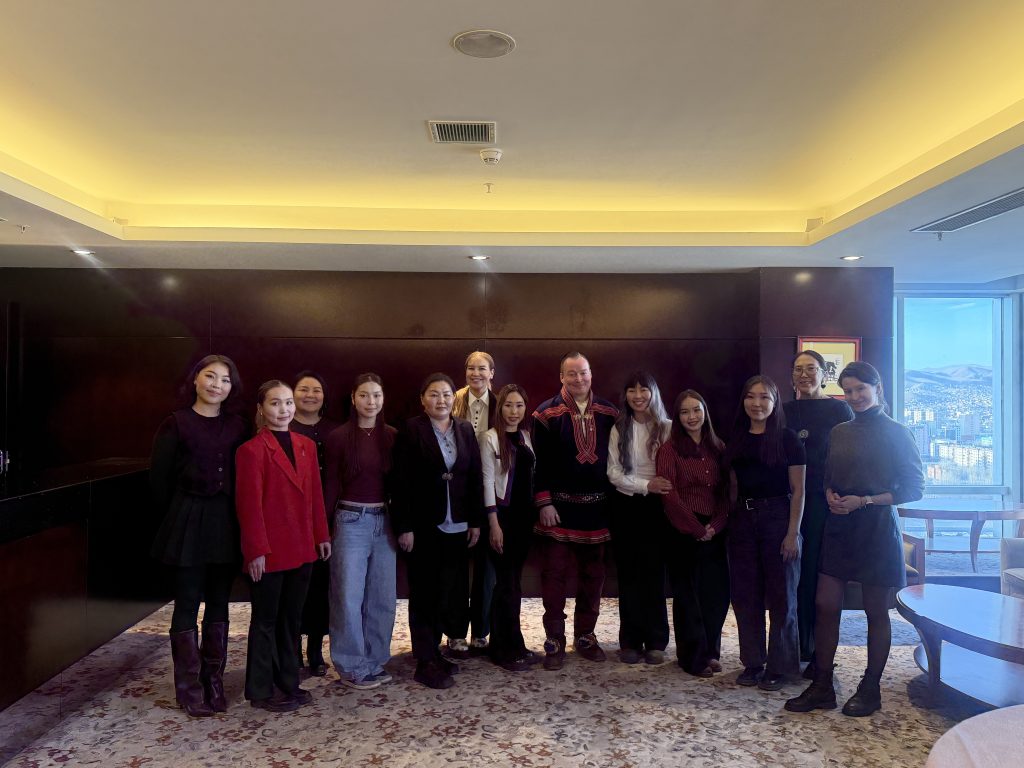
Earlier this month our team went to Ulaanbaatar, Mongolia, for the Reindeer Herding and Resilience Project Steering Committee meetingProject Steering Committee meeting and the launch of the Traditional Knowledge Documentation Course. The objective of the Project Steering Committee meeting was to present the project implementation results and to review and approve the 2026 Annual Work Plan, Budget, and Procurement Plan.
The project Component 3 team was presented by Marina Tonkopeeva (ICR), Anders Oskal (ICR, WRH), Binderiya Dondov (ICR), Khongorzul Mungunshagai (Dukha reindeer husbandry representative), and Svetlana Avelova (ICR). Opening remarks were given by Mr. Sh. Batbayar, State Secretary, Ministry of Environment and Climate Change (MECC), Mr. Ersin Esen, Coordinator a.i., Global Environment Facility Coordination Office, UNEP/GEF, and Mr. Anders Oskal, Executive Director, International Centre for Reindeer Husbandry (ICR).
This was the second Steering Committee Meeting and it brought together key project partners and stakeholders to review progress, align priorities, and guide the next phase of implementation. The meeting reinforced collaboration between international organizations, national institutions, and Indigenous representatives, ensuring that the project remains focused on enhancing climate resilience, sustainable land use, and the livelihoods of reindeer herding communities.
The launch of the Traditional Knowledge Documentation Course marked a concrete step toward these goals by directly engaging representatives of the Dukha reindeer herding community. The course focuses on documenting Indigenous knowledge systems—especially those related to land use, herding practices, and environmental stewardship—and strengthening participants’ skills in preserving and communicating this knowledge.
After completing the course, students will be able to explain core concepts of traditional knowledge and related terms, describe why traditional knowledge is important for culture, identity, ecology, governance, and sustainability, understand ethical principles relevant to the documentation, gain knowledge of methods for documenting traditional knowledge, and understand its importance in sustainable development.
The course will run later this year.
More information you find on reindeerherdingandresilience.org