Published in Pastoralism: Research, Policy and Practice. Volume 16 - 2026 | https://doi.org/10.3389/past.2026.15834
Inger Marie G. Eira, Mathis P. Bongo, Mia Carina E. Jægervand, Anni M. Magga-Eira, Inger Ellen J. E. Gaup, Anders Oskal, Marina Tonkopeeva, Rauna Triumf, Ravdna Biret Marja E. Sara and Svein Disch Mathiesen
This article examines how Norwegianization and subsequent governance reforms have reshaped Sámi reindeer herders’ understandings of sustainable reindeer husbandry as a nomadic pastoral system operating under non-equilibrium Arctic conditions. While assimilation’s effects on language and identity are well documented, its consequences for pastoral learning systems, household governance, and adaptive capacity remain less systematically analysed. Drawing on interdisciplinary research, policy documents, and testimonies to the Norwegian Truth and Reconciliation Commission, the article provides a thematic synthesis of how state rationalization, educational restructuring, and administrative standardization have reconfigured Sámi Indigenous pastoral knowledge. The analysis shows that assimilation operates through governance mechanisms that translate Sámi professional language, siida-based organization, gendered earmark rights, and place-based ecological knowledge into standardized administrative categories. Reforms introduced from the 1970s onward privileged equilibrium-oriented and production-based indicators, marginalizing flexible, mobility-centered pastoral logics. Over time, these governance transformations have interacted with globalization, infrastructural expansion, land fragmentation, and climate change, intensifying pressures on seasonal mobility, pasture access, and the annual cycle central to nomadic pastoral adaptation. These processes have weakened intergenerational knowledge transmission, narrowed learning arenas, and redefined land-use competence as regulatory compliance rather than adaptive navigation of variable socio-ecological systems. Under accelerating climate change and land-use fragmentation, the resilience of Sámi reindeer husbandry depends on restoring coherence between language, mobility, household-siida organization, and practice-based learning. The article argues that seanadit, reconciliation grounded in institutional and epistemic realignment, is a prerequisite for robust pastoral governance in the Circumpolar North.
Read full article
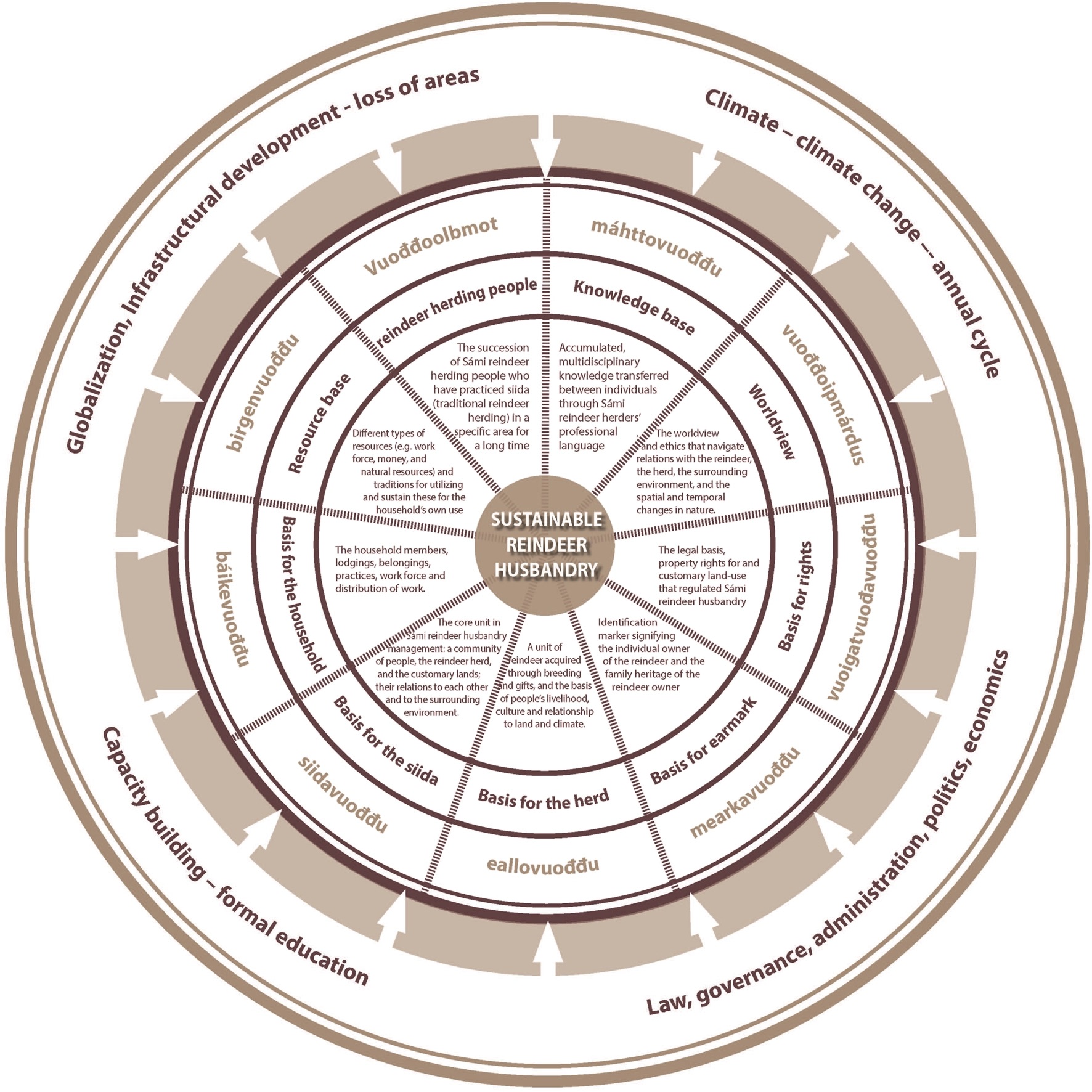
Figure: The nine foundational elements of sustainable Sámi reindeer husbandry (adapted from Eira et al., 2016; Bongo and Eira, 2023; Johnsen et al., 2023) designed by Gunnlaug Ballovarre, Nasjonalt senter for samisk i opplæringa, Sámi University of Applied Sciences.